
In Lesson 1 we looked at the stink coming from Tamala Park.
Now we need to talk about what sits underneath it.
Leachate is the contaminated liquid created as rainwater passes through waste, picking up chemicals and organic material along the way.
Think of it as bin juice, on an industrial scale.
MRC managed this leachate through extraction pumps and evaporation ponds. Then, in February 2023, amid pressure over rising odour complaints, MRC stopped extracting and evaporating the leachate because the ponds had been identified as a possible source of the smell.
By 2024, consultants had identified this decision as the most significant operational change before the subsequent increase in odour complaints. And to be honest, it’s a decision I find very hard to make sense of.
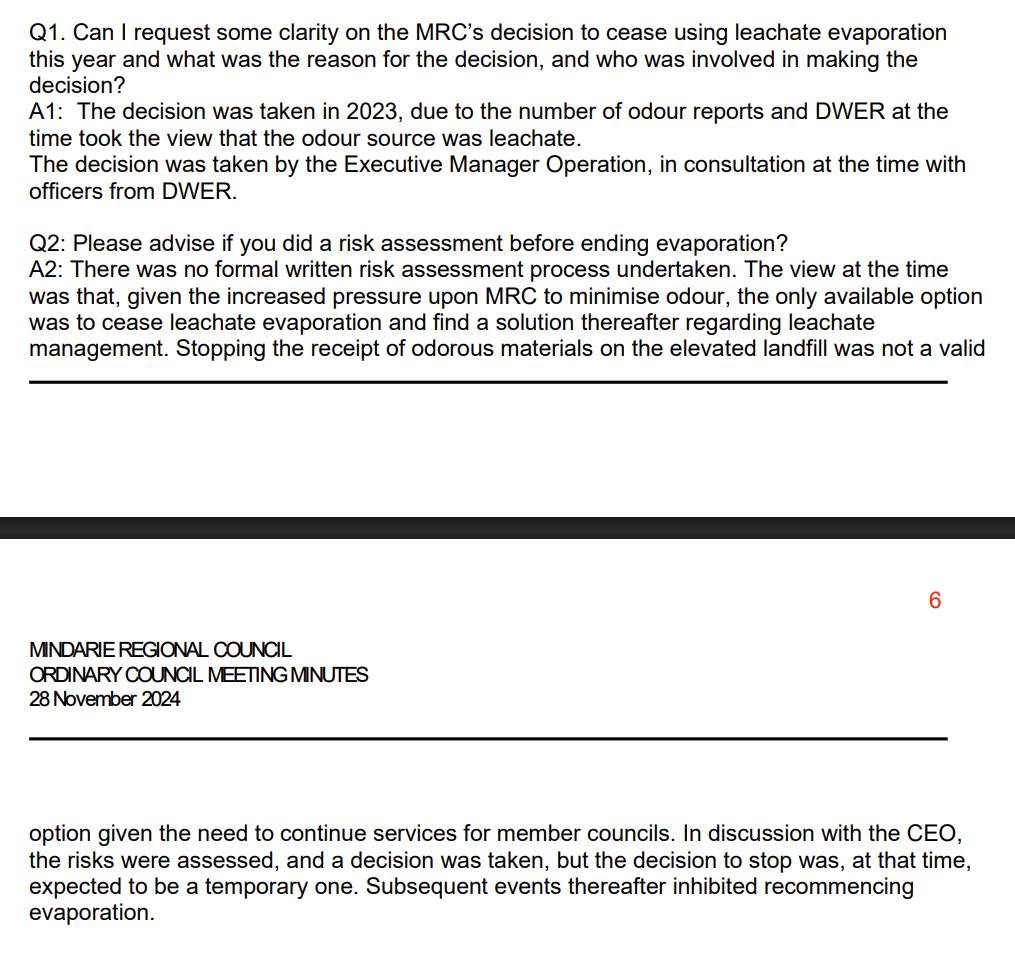
Particularly since, as revealed in an answer to a public question in November 2024, no formal written risk assessment was undertaken. Worse, if there was a Plan B for what to do with the leachate, it wasn’t enacted. The bin juice just stayed and accumulated within the tip.
And leachate does not simply smell in its own right. As it accumulates, it can saturate the waste mass and flood the landfill-gas collection system, reducing its effectiveness. The gas is still being produced, so if less is being captured, more can escape, exacerbating the odour problem.
Notably, and this goes to my argument for moving away from the regional council model, this significant decision to stop the ponds never came before the MRC Council.
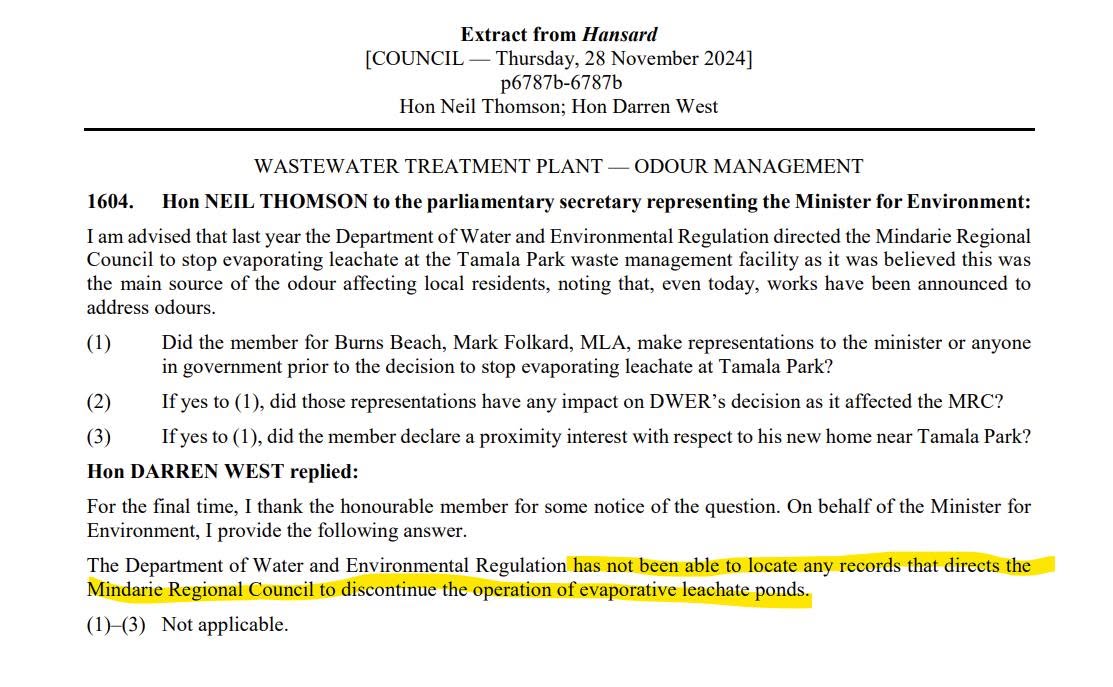
MRC later said the decision was made “in consultation at the time with officers from DWER.” Yet when the matter was raised in Parliament, DWER said it could find no records of the Department directing MRC to discontinue operation of the ponds.
For more than eighteen months afterwards, the leachate continued to accumulate and the odour problem worsened. Yet I can find no Council report reviewing the decision or demanding a clear replacement strategy for the growing volume of leachate being left inside the landfill.
By November 2024, DWER had issued its first Environmental Protection Notice.
Now, in August 2026, the regulator has gone considerably further. Its second EPN requires MRC to develop and implement a Leachate Removal Plan, reduce leachate levels and report every 30 days on both the amount removed and the effect that removal is having on landfill-gas collection.
In other words, more than three years after MRC stopped extracting the leachate, the regulator is now requiring a formal plan to get it back out.
And this is where I come back to the governance model.
I don’t care how awesome each individual member of the MRC is. If I were selecting a board to oversee a landfill, I suspect few, if any, would make the cut.
This is an operation carrying serious environmental, regulatory and financial liabilities, some of which will remain long after the landfill closes. Yet its oversight body is made up of elected members from seven different councils, overseeing issues involving landfill engineering, hydrogeology, gas management, contamination, regulation and major closure costs.
And let’s be honest: these are political appointments. They are chosen by councillors, from among councillors, through council politics. Their credentials for the job may be relevant, incidental or non-existent. The system does not require expertise in the risks they are being asked to oversee.
In almost any other setting, a board responsible for liabilities of this scale would be deliberately assembled around the skills needed to understand and challenge them. Here, we hand the job to whoever wins the numbers in the chamber.
A skilled board could still make a bad decision. But there would be a clearer line of accountability for who assessed the risk, who challenged the advice, who authorised the decision and whether they properly discharged their responsibilities.
Under this model, the expertise is optional and the accountability is diffuse. The liability, however, is very real.
And when things go badly wrong, that liability ultimately flows back to the member councils and the communities that fund them.
That is the lesson about unintended consequences I want to keep returning to throughout this series. Because as we decide what replaces Tamala Park, changing where the waste goes without reconsidering who governs it, risks carrying one of the biggest problems with the old model straight into the new one.
Next up: where all that contaminated liquid goes when parts of a landfill have no ability to extract it.
That is where this story runs much deeper
#wakeupjoondalup
References and resources